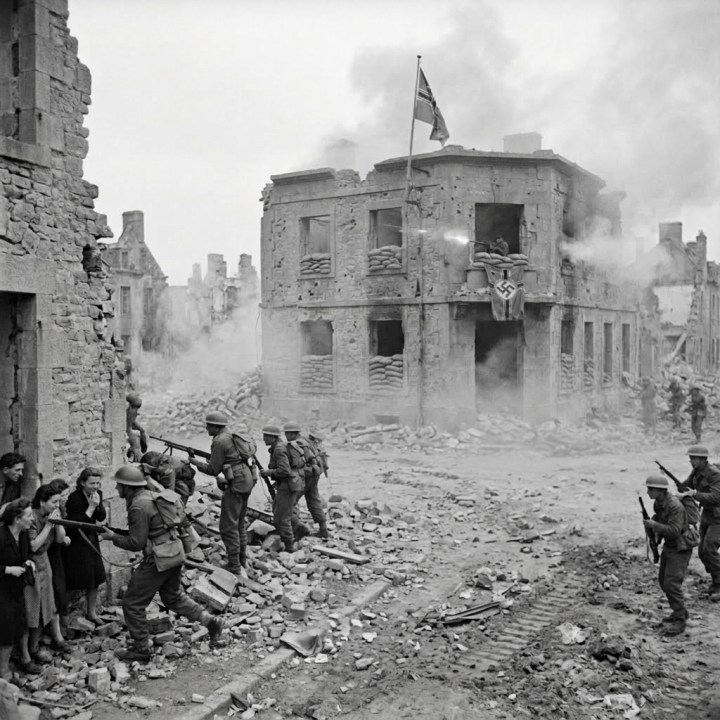
A recent accidental discovery of his father’s divorce record, led me on a fascinating journey to the story of Private Thomas Wallace Govans, my first cousin – twice removed, and the war against fascism in World War 2. He fought with the 2nd Battalion, The Lincolnshire Regiment, at the liberation of Caen, in Normandy in July 1944.
Thomas was born in 1914, right at the beginning of World War 1, in the industrial village of Hurlford, in Ayrshire. His father was Hugh Govans, a pit enginekeeper at one of the local mines throughout his adult life. Thomas was the youngest of four children born to Hugh and his third wife, Susan Gorman – a lass from Belfast.
The family moved between the villages of Hurlford and Crookedholm in a tightly knit community surrounded by their extended family members. At the age of twenty-five in 1939, Thomas married Mary Margaret Creighton, a girl born in Cambuslang but living in Kilmarnock. They had one child together – Thomas Wallace Govans, called after his father, born in 1943.
Thomas wasn’t called up to service when the war broke out against Germany in September 1939. He became a private with the 2nd Battalion, The Lincolnshire Regiment much later. Thomas was a lace weaver and this highly skilled job came under the government’s reserved occupation scheme. Textile workers were protected from call-up until they were thirty years old. The reserved occupation scheme eventually tightened as the war ground on and by 1942-43, the army was running short of infantry.
So – how does a lace weaver help the war effort? The answer to that is parachute production. Thomas lived and worked in Galston, one of the small towns in Ayrshire that make up the Irvine Valley, and this is where most of the parachute fabric to supply Britain’s needs in WW2 was manufactured.
Mills such as John King & Sons; Morton, Young & Borland; Henry Ballantyne & Sons – all in Newmilns, along with AF Stoddard in Darvel, all took part in producing a range of woven items needed for the war effort. The Glaston textile mills were smaller but made a huge contribution to the production of parachute silk and webbing.
To begin with, the parachute fabric was made of silk or rayon but as technology progressed, the new man-made fabric called nylon was introduced to the weavers. Other items supplied by the Irvine Valley weavers were lightweight netting, medical gauze and bandage cloth, camouflage netting, webbing and straps.
A few months before war broke out, Thomas married Mary Margaret Creighton, a lass living in Kilmarnock, who was a wool reeler – a skilled job using machinery to wind wool yarn from bobbins onto reels, swifts, or skeins, keeping the thread even, unbroken, and correctly tensioned. They married in the Henderson Church in London Road, Kilmarnock on 28th July, 1939.
Thomas was living at Burnhouse Cottages in Galston and Mary lived with her family at 64 Dean Street, Kilmarnock. Perhaps they worked and met at the same mill in Galston. By 1943, their son, also called Thomas Wallace Govans was born – but what of his father at this time?
Up until this point in the war, a skilled weaver was more valuable at home than a man in uniform. But everything changed. By 1942, the army was running short of infantry. In response to this, the government began to lower the age of conscription within reserved occupations. They re-assessed which trades were essential. This meant that older men, nearing their thirties, began to be called up. Thomas was one of these men.
By 1942/43, the British Army used General Service Training Centres (GSTCs). An Ayrshire recruit like Thomas would likely have gone to No.20 Primary Training Centre at the Maryhill Barracks in Glasgow to carry out his 10-12 weeks of basic training.
Thomas would then most likely have been moved on to do his Infantry Training of 12 -16 weeks. This took place at four different centres across Scotland – Aberdeen, Glencorse, Lanarkshire, and Berwickshire.
When this five to six month training period was completed, Thomas would have been sent to a holding Battalion for Scottish recruits in Edinburgh, Perth or Glasgow. This is where Thomas would spend months, waiting to be deployed.
Finally, Thomas would have been sent to No. 30 Infantry Base Depot – Normandy in the Bayeux area of France. This was where the 3rd Infantry Division, which included the 2nd Lincolnshire Regiment was based. By the time Thomas reached the 2nd Lincolnshires, the battalion was already in Normandy – he was being sent with other reinforcements following D-Day on 6th June 1944.
The Lincolnshire Regiment had landed on Sword Beach as part of the 3rd Infantry Division. Their task was to secure the beachhead and push inland. They landed in deep water up to their waist under light shelling. Snipers were active and enemy aircraft was attacking the beach. By 18:00, the Battalion, under the 8th Brigade, was commanded to hold the left flank of the the beachhead. Only one soldier was killed and one injured on this first day.
However – things were about to change. During the 7-8th June 1944, the Lincolns experienced one of the most viscious battles of the Normandy Campaign – The Battle of Cambes-en-Plaine. This was a fortified German position held by the 12th SS Pantzer Division called the ‘Hitlerjugend’. They were the most fanatical and aggressive troops in the whole of Normandy. Braving tanks, mortars, machine-guns, snipers, counter-attacks by the SS Infantry, the Lincolns were ordered to hold their ground.
It was a bloodbath. In the next 48 hours, the Lincolns lost over 250 men, who were either killed, wounded or lost. A British Infantry Battalion was made up of 800-850 men. By the end of the first week in Normandy, they were down 400-500 men. On a daily basis, drafts of 20, 40, 60, men were sent to the front. Thomas would have been in one of these drafts.
In the days following D-day, the main objective for the British Army was to take the city of Cean, nine miles inland from the beaches. Operation Perch on 10-14 June was their first attempt as they tried to encircle Caen from the west. However, the Germans were too strong and the operation failed.
Operation Epsom was an attempt to outflank Caen on 26-30 June. But again this failed. A new strategy was devised by the British, and Operation Charnwood, carried out over 8-9 July, was the first time British strategic bombers were used to directly support the ground forces in Normandy.
This time the offensive was successful, and the British and Canadian forces managed to capture the northern half of the city. Understandably, much of the city was destroyed by the bombing and many French civilians were killed. This offensive caused around 3817 Allied casualties – killed, wounded or lost.
Thomas fell on the first day of Operation Charnwood. At this time, the Lincolnshires were attacking the north of Caen against the 12th Panzer Division. On that day alone, 1500-1800 British and Canadian soldiers were killed, wounded or went missing.
The 2nd Lincolnshires were specifically attacking Lebsey Wood on the northern appraoches to Caen. This was one of the most heavily defended areas of the whole operation. On the 8th July, 40-50 Lincolns were killed alongside Thomas. They suffered one of the highest casualty rates of any British Battalion on 8th July 1944.
They had to advance over open ground, under machine-gun, mortar, and anti-tank fire. They were being commanded to push into an enemy line that had alread held off multiple attacks since D-day. This was the environment in which Thomas fell.
It is likely Thomas only fought in France for two to three weeks before his death.
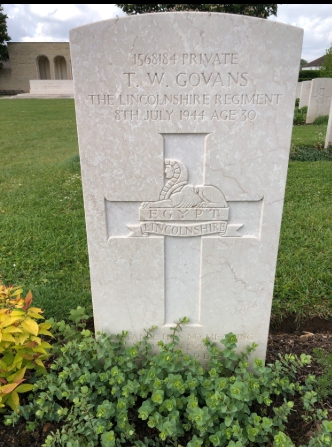
Back home in Ayrshire, Thomas left a young wife and son. Mary was 87 years old when she died in Dalry, Ayrshire in 2003. Thomas is buried at Ranville War Cemetry, Departement du Calvados, Basse-Normandie, France. He was 30 years old. He never returned home.
Discover more from Discovering My Family
Subscribe to get the latest posts sent to your email.


