
The information in this post is based on the research by Tony Whelan, a descendant of Andrew Ballantyne.


Nothing more is known until 1851. Andrew Ballantyne, who was still of the Church of Scotland, married a twenty-two-year-old Irish woman. Her name was Mary O’Dowd, and they married at St Francis Catholic Church in Melbourne. Mary had arrived in July of the same year on the John Knox as an assisted immigrant. It may be supposed she ended up working on or near the same sheep run that Andrew worked on. In any event, it seems they soon joined the throng of people moving to the Castlemaine area in west-central Victoria. This was most likely due to the discovery of gold that year.
According to Castlemaine historian Robyn Annear, gold was found in many places in Victoria during the 1840s, mainly by shepherds and farm labourers. Their finds were mainly kept secret, as mining was illegal, all gold (and other metals) being the property of the Crown.
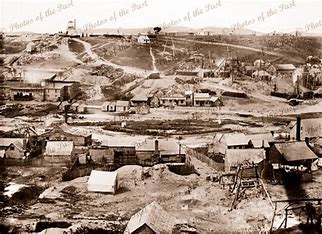
The gold rush to New South Wales in 1851 made it clear that the new colony of Victoria (till then a district of NSW) might lose its entire labouring population to the NSW goldfields. A committee was soon formed to promote and reward gold discovery in Victoria.
In July 1851 a shepherd found gold at Specimen Gully (5 km north-east of Castlemaine). Soon all of the area’s streams were being scoured by hopefuls from all over the world. Annear says that by 1852 it is thought that there were some 25,000 people on the diggings around Castlemaine, living in shanty towns of canvas tents which housed stores, the first school (1852), dwellings, sly-grog shops and even an office of the Bank of NSW (also 1852).
Andrew Ballantyne’s younger brother Walter, was one of many assisted immigrants coming to the colonies to start a new life. He would want to get away from the destitution faced by people in Scotland and Ireland in the mid part of the nineteenth century. He appears to have arrived in Tasmania on the Ocean Chief on 25 March 1855. He was described as single, a shepherd from Ross-Shire. In 1858 he married Mary Flynn, a bounty immigrant from Ireland. They had several children in Tasmania before moving to Victoria in the mid 1860s.

Andrew and Mary Ballantyne had ten children in the Castlemaine area in Australia between 1852 and 1870. Sadly, not all survived. They lost their first child, Helen Mary fifteen months after she was born. Her sister, Bridget, died in 1855. Eliza and Andrew both died in 1868. He was less than one-year-old and Eliza was three-years-old. They died less than a month apart.

It is also believed that Mary had a brother Michael O’Dowd. He migrated to Melbourne in 1860 with his wife Ann (Guerin) and their four children. They too ended up in the Castlemaine area. The likely connection between the families is evidenced by the fact that a single grave in the Castlemaine cemetery contains five O’Dowd children (4 died 1863, 1 in 1868) and two Ballantyne children (Andrew and Eliza, both died 1868). Looking at the death certificates, it is clear that epidemics of illnesses such as enteritis claimed many young children.
Michael and Ann O’Dowd had at least two children (both daughters) survive to adulthood and marry. Their families farmed land near Bendigo, Mildura and Winchelsea at various stages. Michael and his wife died at the home of their grandson John Malone in the early 1900s. The connection between Mary O’Dowd and Michael O’Dowd has not yet been proved to 100% satisfaction. The fact that County Clare records are not online makes it very difficult to do much at this time.
It is also believed that Mary had a brother Michael O’Dowd who migrated to Melbourne in 1860 with his wife Ann (Guerin) and their four children. They too ended up in the Castlemaine area. The likely connection between the families is evidenced by the fact that a single grave in the Castlemaine cemetery contains five O’Dowd children (4 died 1863, 1 in 1868) and two Ballantyne children (Andrew and Eliza, both died 1868). Looking at the death certificates, it is clear that epidemics of illnesses such as enteritis claimed many young children.
Michael and Ann O’Dowd had at least two children (both daughters) survive to adulthood and marry. Their families farmed land near Bendigo, Mildura and Winchelsea at various stages. Michael and his wife died at the home of their grandson John Malone in the early 1900s. The connection between Mary O’Dowd and Michael O’Dowd has not yet been proved to 100% satisfaction. The fact that County Clare records online are expensive to access, makes it difficult to do much at this time.
Other researchers of births in the Castlemaine area should note that although Catholic records were required to be submitted for inclusion in the state registers from 1855, there is no trace of some of the post-1855 family births in official records. However, a number of the missing records were located in copies of the Catholic baptisms held by the Castlemaine Historical Society.
Andrew and Mary Ballantyne lost four of their ten children as infants or toddlers. One of the surviving daughters was the author of this story’s great-grandmother, Ellen Ballantyne, born in 1863 in Castlemaine. In 1883 at age 19 she married Edward Dwyer from Wilcannia, NSW, but had divorced him by 1890. In 1891 she married George Hildebrand and their daughter Bertha is the author’s paternal grandmother.

Andrew and Mary’s only son to survive to adulthood was John. He married his cousin Agnes (born in Tasmania to Andrew’s brother Walter). John and Agnes moved from suburban Flemington to the Castlemaine (goldfields) area. Then in late 1892 they relocated to the mining centre of Broken Hill, in far west New South Wales. John worked in the mining industry, as evidenced by an entry in the member’s payment ledger for the Barrier Branch Amalgamated Mines Association of 31st March 1904. Three sons were born there, two of whom (John junior and William) survived.
Some time after fire destroyed their Broken Hill home in January 1909, the Ballantynes journeyed to Western Australia to seek work at the gold mines in Boulder. A number of related families also ended up in the west around that time, including John’s daughter Annie and her husband Thomas Tupper.

The rail link to the west was not completed until 1917. The only way to make the greater part of the trip would be by ship from Adelaide to Fremantle, or by going overland. The vast expanses of the continent were then being navigated by teams of Muslim cameleers from India and Afghanistan. The oral tradition is that the families travelled from Broken Hill to Boulder in such a camel convoy. A journey of around 870 miles. This would be an extraordinarily demanding enterprise. The Ballantynes are made of tough stuff!
By 1916 John and Agnes are recorded on the electoral roll at Boulder, and John remained there till his death in 1923. Some time after 1925, Agnes moved to North Adelaide to live with her daughter Annie and husband Thomas (Tupper), and she died there in 1938 aged 78.
Agnes and John’s son John junior served in World War One and on his return married in Adelaide but moved back to Boulder. He later divorced and married again, settling in Adelaide; the two families were apparently ignorant of each other’s existence for decades. His second wife divorced him when the children were young and later in life John lived with his son Don in Melbourne and died there in 1962.
John’s brother William married in Boulder but settled in Adelaide. He had four daughters and two sons, and died in 1954.

It’s quite extraordinary to see how Andrew Ballantyne’s family grew despite harsh conditions and times of great sadness. Andrew, yet again, showed great strength and resilience to the end of his life.

Discover more from Discovering My Family
Subscribe to get the latest posts sent to your email.

 Discovering My Family