
Do you have a hobby that makes people laugh? Like many people who research their ancestors, I enjoy wandering around graveyards. That always gets a giggle from people. I love reading old gravestones with partially obscured lettering. There’s always more to find than names and dates. Many stones tell their own stories of children lost too young. They also tell of family who died on the other side of the world but are remembered on the stone. There’s always something interesting to find.
I also study names on war memorials. I always look for my family names, Ballantyne, Campbell or Govans.These brave long-gone people intrigue me. I scamper home to check out my photographs. I want to see what more I can discover about a name I have found.

I can’t claim that I found Martha Robertson Minto. She was mentioned by the minister at the Remberance Service at Hurlford Kirk in Ayrshire. I’ve often looked at my village war memorial. To my surprise, I had never noticed that among all the men listed from both wars, was a woman – Martha Minto. After her name are three initials, WLA. These letters stand for Women’s Land Army. But why is Martha’s name on the war memorial? More importantly, who is she? What is her story? I set off to try to answer my questions.

Martha Robertson Minto was born on 15 June 1924. She was the daughter of Thomas Minto, a general labourer, and Jean Robertson. Although I’ve searched through many records, I’ve still to discover Martha’s place of birth. Later on in life, the family were living at 47 Morris Crescent, Hurlford, Ayrshire. This may or may not be where she was born.
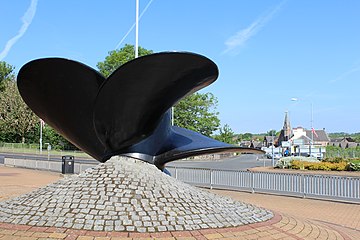
At the time of her birth, Hurlford was a hub of industry. It was mostly known for its ironworks industry and the Portland Ironworks. Standing on the banks of the River Irvine looking down on Crookedholm, the ironworks employed many people from the village. To feed the furnaces, there were several pits around the local area and many rows of miner’s cottages. Many of my ancestors were miners from this area. The iron was used to make everything from propellers for ships to grates for drains. The mark ‘Hurlford’ can still be seen on many manhole covers.

The school dominates the village. Now a ‘B’ listed building, the red sandstone school was built in 1905. Many generations of my family were educated there since it opened. It is likely that Martha would make the short walk each morning down the hill from Morris Crescent to the ‘skuil.’ The school was a Junior Secondary School at the time Martha attended. It catered for boys and girls from the age of five to fourteen.
There were three doors into the school. One was for Infants, one for girls and at the far side of the school, up the steps, was the boys entrance. If you look today, you can clearly see these words in the red sandstone above each door. Inside, the school has a central hall with stairs at each end leading to the classrooms upstairs. A balcony surrounds the upstairs. It was an imposing building for many a five-year-old.
When Martha attended between 1929-1938, there were no inside toilets. They were in a separate block between the girls and boys’ playground. The toilets were still a long walk outside when I was a pupil there between 1966-1973. The shiny toilet paper is still a strong memory.

Martha would have many friends. After school, they could roam around the village to the Cross and visit the shops. These are all gone now, but in the heyday of the village, there was a butchers, bakers, post office, bank, newsagent, cafe, a couple of pubs, to name a few. It was a lively place to live. Heading up Mauchline Road, Martha would visit the Co-operative or the fishmonger.

At the Cross, Martha would see the Institute. This was another grand sandstone building. It had a hall and a reading room. It was an important hub for the community and held many cultural and social events.
Walking across the bridge that spans the river Irvine, Martha may have gone to church on a Sunday with her family.

First on the right, in the neighbouring village of Crookedholm, was the Reid Memorial Church. Earlier in its history is had been the Free Church of Scotland. Walking further along the road, the imposing red sandstone Hurlford Kirk with its square tower,welcomed local people. The bells of both churches would compete with each other every Sunday morning. Hurlford Kirk gave a loud ‘dong’ every three seconds. The other church had a lighter bell that gave a double ring every two seconds. Martha would be very familiar with these sounds.

What happened to Martha after she left school? The years between 1938 and 1942 are lost. It’s possible that Martha worked in one of the local shops. Maybe she travelled into Kilmarnock each day on the bus to work. The trams that had run from Kilmarnock to Hurlford had been replaced around the time of Martha’s birth. I’m sure in some future census someone will find out what she did during this period of her life.
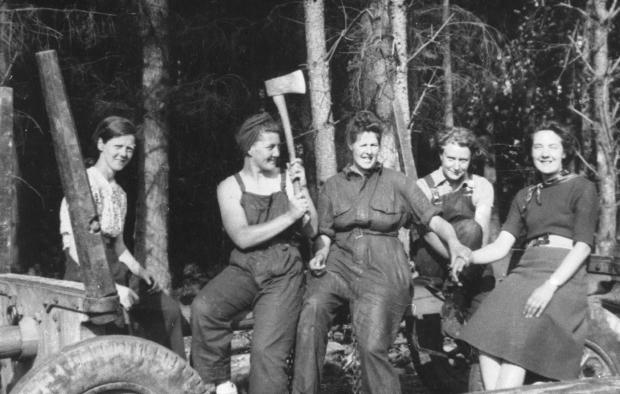
Martha’s story emerges around 1942. The war had been going on for three years. By this time, Martha would be used to the blackout, air-raid wardens, and rationing. By 1942 Martha would have been eighteen years old. This is when she played her part in the war effort.

Martha joined the Women’s Timber Corps. She was very young but the minimum age was seventeen, so she joined up. Martha was assigned to the West & South Division. By 1942 the country needed to meet the increasing demands for timber. The German occupation of Norway had cut off supplies of much needed wood.
Known as Lumber Jills, the women were trained to work in forests and saw mills. They were then posted wherever they were needed and moved around the country from job to job. The women worked alongside men and learned to chop down trees. They also learned how to load logs onto a lorry. Additionally, they learned how to measure trees. Their day began at seven in the morning and ran to four thirty in the afternoon. As part of their interview process, the girls had to pass a strict medical examination.

They were given a uniform of a green beret and a hat badge which showed a fir tree. They were also provided with jerseys, breeches overall coats, dungarees, knee socks, knit shirts, boot and shoes. For colder weather they had a heavy Melton overcoat. For wet weather, they had an oilskin. The women adapted their outfits in a bid to be comfortable and practical for specific tasks.
There was great comradery among the women. Although the work was strenuous, they supported and encouraged each other. I can imagine Martha having a wonderful time. As some point before 1945, Martha met a young man from London who was a plumber in the Royal Navy.
They fell in love and married on 14 December 1945 at Hurlford Kirk in Crookedholm. Henry Thomas Chalkright was twenty-two years old and Martha was twenty-one years old. His father was a painter and decorator. He and his wife, Jessie, lived at 10 Harrington St, Hampstead Road, London, NW1. This is near Camden. it states in the marriage certificate that Martha was part of the Women’s Timber Corps.
The young couple left Ayrshire after their marriage and headed to London. They moved in with Henry’s parents at Harrington Street. Martha fell pregnant almost immediately after her marriage. Around 8 August 1946, just short of thirty-three weeks since her wedding, Martha was admitted to University College Hospital in Euston Road, London.

It was discovered she had heart problems which were very challenging at the thirty week point in pregnancy. She would have shortness of breath, chest pain and fatigue. Despite the best efforts of the medical staff, Martha died, along with her baby. Henry must have been heartbroken. It was found that Martha had valvular heart disease. She had a narrowing of the aortic valve causing aortic stenosis. She also had mitral stenosis, causing a restriction of blood-flow to the left ventricle.
Treatment in 1946 was very different from today. The doctors would have tried to manage Martha’s symptoms with medication such as diuretics and vasodilators to reduce the workload on the heart. Surgical intervention was in its very early stages, so this wouldn’t be an option for Martha. Such a tragic end for a young girl and her baby.

Have I answered my questions? I now know who Martha was and a bit of her story. I still don’t know how her name came to be on the war memorial. This will need some more research.
Henry married again in 1947 to Pamela Phillips in London. He died, age sixty-two in January 1986 and was still living in Camden, London.

It’s amazing how much can be discovered with a little research. I’m pleased to have met Martha, a young, independent and courageous woman. On 10 October 2007, Forestry Commission Scotland unveiled a national memorial to the women of the WTC. The memorial is a life size bronze sculpture by Malcolm Robertson. The statue is in the Queen Elizabeth Forest Park near Aberfoyle.
Discover more from Discovering My Family
Subscribe to get the latest posts sent to your email.

 Discovering My Family