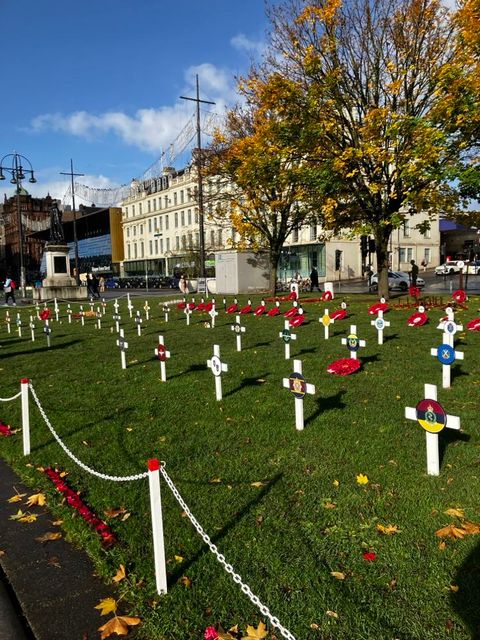
I was walking through George Square in Glasgow the other day. There was a mixture of people, some holding poppy wreaths. I was intrigued as it is a few weeks yet until Armistice Day. I crossed over to take a closer look. On one of the grassy beds in the Square, rows of white wooden crosses were placed side by side. On each cross was the emblem of a regiment. I also noticed a few gravestones had been placed behind the crosses.
A quick investigation explained what was going on. This was an installation to promote the launch of the 2024 Poppy Appeal. Personal dedications can be made and a small wooden cross with a poppy can be placed beside the appropriate regiment. I think this is a very touching idea.

I went on my way thinking about my ancestors who were killed fighting in WWI. I will visit George Square to pay my own personal tribute before Remembrance Day on Sunday 13 November. I realised I first needed to refresh my memory about those my family and village lost.

On the War Memorial in Hurlford/Crookedholm are the names of three young men. They each bear the name Govans. Two of the young men are my first cousins, twice removed, and also brothers.

I have not yet managed to discover how the third Govans fits into my family but he’s there somewhere. No matter, he was from my village. His story is well worth telling and he is the first soldier I will pay tribute to at George Square.
James Govans was the son of a miner. His parents, James and Elizabeth, met and married in 1889. They both lived in Crookedholm, a small village on the main road between Hurlford and Kilmarnock. Elizabeth was already a widow at twenty-one. She married for the second time and had several children with James Govans. She already had two young children, Janet and William from her first marriage.
Son James arrived in 1893, three years after his brother, Alexander. In time, he also had a younger brother and two younger sisters. They all lived together at 17 Portland Row in Hurlford. Many members of my family lived there at that time.

Both Alexander and James joined up when the war against the Germans came to Europe. Alexander joined the Scottish Rifles and fought until 1916. He then joined the Labour Corps in 1919. For a year, he dug graves in France. He had to return home with chronic bronchitis.
Younger brother James joined the 6th Battalion of the Royal Scottish Fusiliers in Ayr. This battalion was formed in August 1914 and was part of Kitchener’s New Army. With other battalions they formed the 27th Brigade under orders from the 9th Scottish Division.

The Ayrshire lads set off by train for Bordon in Hampshire, on February 1915. Bordon was a training camp and a base for Canadian forces. It prepared troops to fight on the front line. Row upon row of tents became home, for a short time, to thousands of troops. The camp also had a hospital and an outdoor theatre with a stage. James left for the port town of Boulogne in France on 12 May 1915.

From there, the Scottish Battalions headed for the Western Front surrounding Ypres, in the Flanders district of Belgium. James arrived at the front line in the middle of the Second Battle of Ypres. The battle lasted from 22 April 1915 until 25 May 1915. Young James must have been incredibly shocked. He arrived in the trenches as the battle raged around him. The noise from the constant bombardments alone must have been terrifying. Reports tell of badly repaired, water-logged trenches. They had been damaged by German attacks and machine gun fire. Both Allied and German bodies lay dead in No Man’s Land.

These fresh troops would have heard about the deadly use of gas. After all, it had been deployed by the Germans only a few weeks before. A green and yellow cloud had drifted from the German line at 5pm on 22 April 1915. It rolled towards Canadian and French Algerian troops who were defending that part of the line. The gas spread over 1km, shocking the Allies with its size. Many men from the 87th Division were totally asphyxiated in an area known as the Triangular Wood. Those who could, ran away from the front line in terror, gasping for breath, leaving their guns and weapons behind.

Within an hour, the whole position was abandoned. Terrified men in agony, ran through fields and hedges trying to escape the fumes. The gas caused eyes to smart, throats to burn, chests to ache, and made breathing impossible. After a short time soldiers started to spit up blood and roll on the ground, shouting for water. It was chaos.
By the end of that day a heavy bombardment began. The Allies tried to regain the ground that had been lost. The Second Battle of Ypres had begun, and would last until 25 May 1915.
Thankfully, James avoided the chlorine gas. Still, he and his Battalion endured heavy artillery fire. This bombardment lasted for weeks. James was made a Lance Corporal while fighting in the battle. Being a miner, James was used to harsh conditions. He led a few men. He did his best to repair the trenches while they fought. He must have taken his responsibilities seriously and have been deemed trustworthy.
There were significant loses on both sides in the months that followed the battle. Conditions continued to worsen. The threat of gas was never far from anyone’s mind. During this time, James would get letters from home to which he could reply. This must have boosted moral. It reminded these desperate soldiers that there was a world and people back home worth fighting for.

For James, sadly, there would be no going home. He was killed in action on 29 July 1915. He was most likely killed by the heavy bombardment of the trenches by the Germans. He is buried at Pont-du-Hem Milliatry Cemetry, La Gorgue, Nord-Pas-de-Calais in plot VI E. 26. He was twenty-two years old.

James had answered Lord Kichener’s call to arms when war broke out in August 1914. The 6th Battalion were all recruits; factory workers from Glasgow and miners from Ayrshire. The 6th Battalions colours carried between 1909-1920 can be seen at St. Giles Cathedral in Edinburgh.
James’ family received his Victory, British and Star medals postumously in 1919. In the Register of Soldier’s Effects, a small War Gratuity was sent to his half sister, Janet. It was also sent to his younger sister, Mary.

James was one of so many young men and boys who lost their lives in WWI. We must remember the sacrifices they made for their country. We should also honour the bravery they showed under horrific circumstances. I shall plant a cross in George Square this year in memory of Lance Corporal James Govans.
Discover more from Discovering My Family
Subscribe to get the latest posts sent to your email.

 Discovering My Family