
People have often left Scotland for economic and political reasons. They have sailed to destinations across the globe. Many Scots sailed to the coast of Australia, with the hope of a better life. Scots had been making the long and dangerous voyage to Australia from 1787. Eleven convict ships known as the First Fleet arrived at Sidney Cove after an eight month journey. Many Scots headed to Australia during the 1850s gold rush with dreams of great wealth and riches. Other Scots were cleared from their crofts and encouraged to leave their homeland forever.
Highlanders were evicted from their land in the nineteenth century to make way for sheep. These agricultural improvements provided a greater profit for landowners. The crofting life would almost disappear. Displaced and starving people emigrated to Australia, with their passage sponsored by the government. By 1852-1857, government policy was not solely targeted towards the needs of the Highlanders. The focus was on economic growth for landowners.
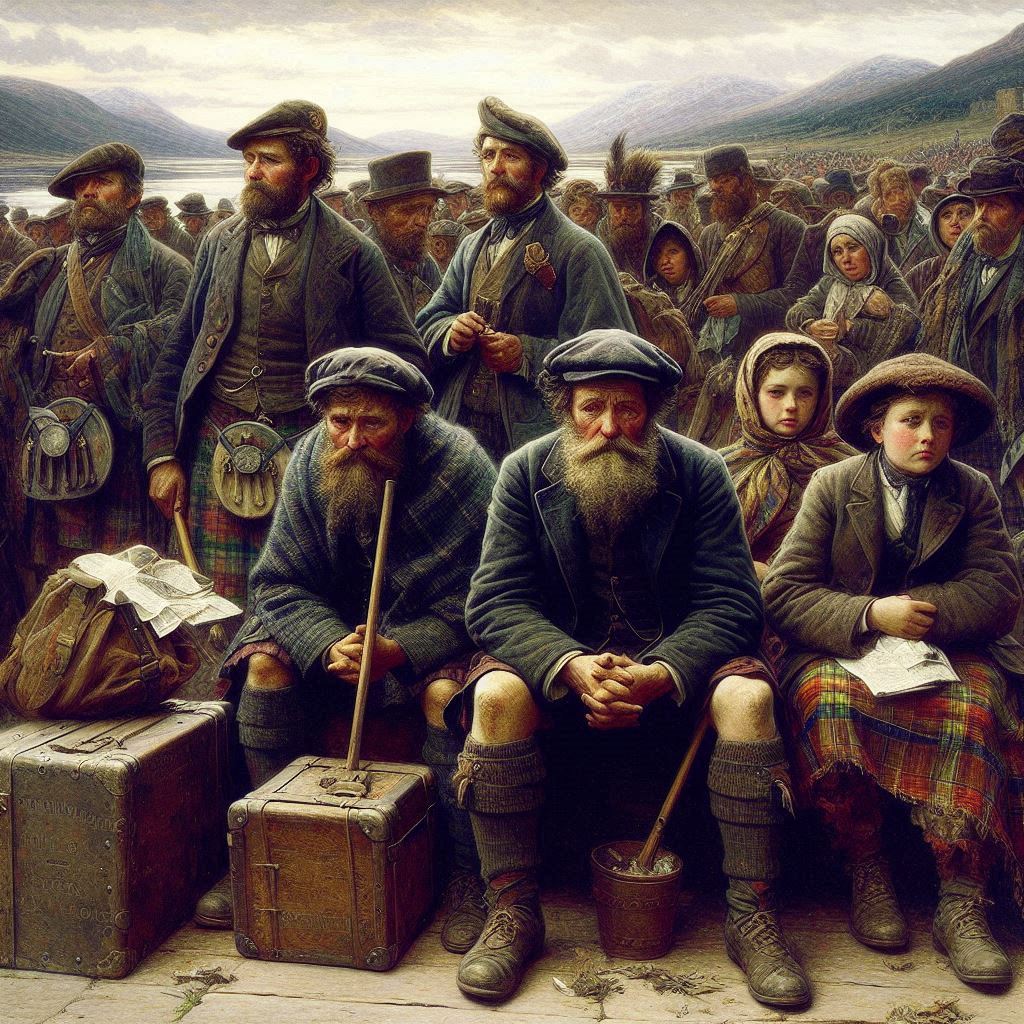
In the early 1850s, famine and despair came to the Highlands of Scotland. The 1846 potato famine in Skye had a particularly devastating effect. By 1848-49, deaths were rising. To help support the people, the government delivered bags of oats along the coast. This was not a long-term solution for the inhabitants’ woes, so a more drastic plan was devised.
In 1852, a new emigration law was passed. It encouraged whole families, sometimes three generations of the same family, to leave their homes in the Highlands. They were promised a fresh start in the colony of Australia. Finance was provided from many quarters, including Queen Victoria. The landowners also contributed to the fund, managed by the Highlands and Islands Emigration Society.
The poorest and most destitute were most often those selected. Many were unwilling to leave their homes, and were given clothing as an enticement. This strategy gave landlords a straightforward method to clear the land and make way for the more economically viable sheep. Between 1852 and 1857, twenty-nine ships carried 963 families, sponsored by the Society. This was approximately five thousand people.
Many thought this was a wonderful opportunity for Highlanders to start again in a country full of promise. Sadly, what happened to the Highlanders, after they stepped on the ship, showed they were in grave danger. The scheme was organised by a quasi-governmental operation, who were very much in the pockets of the landowners. Many later deaths of Highlanders could have been prevented. Unfortunately, poorly regulated systems seemed to focus more on profit than safety.

A perfect example of this lack of care for the highlanders came in 1852. The British Emigration Commissioners in London, chartered an American registered sailing ship, the Ticonderoga. Its task was to transport Highlanders to Australia. The ship’s owners undercut UK registered ships and were given the contract. The cheapest rather than the best ship was used to carry 814 passengers. The recommended number was 630. There was no restriction on the number of children on board, which had previously been the case on other voyages. The Emigration Commission’s remit was to ensure safety and good conditions on the ship. They also had to appoint surgeons who would deal with any illness or accidents during the voyage.
It was quickly discovered very early on, that the Ticonderoga was not suitable. It had inadequate sanitary provision for the number of passengers. Supplies quickly ran dangerously low. The crew of forty-eight was overwhelmed by the amount of people on this twin-decked ship. Decks were not adequately swabbed. No cleaning was done below decks. The ship was overcrowded. A stench hung in the air. Rats scuttled around. Illness soon appeared.
The Ticonderoga left Liverpool docks on 4 August 1852. It was crammed with immigrants. Out of the 814 aboard, ninety-two passengers were English, nineteen were Irish and 703 were Scottish. The first sign of disease appeared one week into the journey when the first emigrant died on 12 August. The surgeon himself, Dr J.C. Sanger, became ill. His assistant surgeon, Dr James Veitch, on his first voyage, had to take over tending the sick. Medical supplies soon ran out as Veitch tried to stem the contamination. The passengers had typhus. So many people died in quick succession. It soon became the practice to bundle the dead into mattresses and throw them overboard in groups of ten. Survivors said that sharks began to follow the ship.

In the weeks that followed, an increased number of people became ill. Their was a lack of ventilation below deck, overcrowding, and unsanitary conditions. The doctor worked hard to contain the illness, but still more people died. The fierce southern oceans, with constant storms, caused more sickness. The passengers were ordered to remain below deck. This was the perfect condition for the further spread of typhus. It became impossible to bury people at sea as the weather became increasingly rough.
The main work for the crew became the removal of bodies. They had to venture below decks, into the disease-ridden hell of the contaminated quarters. The smell alone was hard to bear. During this desperate time, whole generations of families were wiped out; Camerons, Campbells, Fergusons, among others.
Typhus is spread by lice, fleas, and mites, so the over-crowded decks were the perfect breeding ground. The Ticonderoga finally arrived at Port Phillip Bay on 3 November 1852, showing the yellow flag of contagion. The official death toll was 168 passengers and two crew members. There was panic in Melbourne as news of the conditions onboard the ship became known. Of those who survived the journey, four hundred passengers were still seriously ill. The ship was put into quarantine to avoid further contamination. It was sent around the coast to a safe area where the ship dropped anchor.
Many people died at the quickly built quarantine station. Bodies were hastily buried in shallow graves. Double-decked ships were later banned for such long journeys, after an uproar in the Melbourne press. The UK government passed a new law reinstating restrictions on the number of children allowed on a voyage.
Some of the sick began to improve once they were ashore. They received proper nutrition in quickly built sanitary facilities. This did not prevent another eighty-two people dying over the next six weeks. A government inquiry months later found that overcrowding on the ship was at fault.
The treatment of the Highlanders, vulnerable people, is shocking. The Highland landowners benefited financially by making the most of the scheme to remove people. There was also an amount of racism shown towards Highlanders by the government and the Highland and Island Emigration Society. They expressed an opinion that it would do Highlanders good to mix with people of diverse cultures. The undertone being that Celts were a lazy and unintelligent race.
People continued to flow from Scotland over the years, despite the awful experience of some people. Slowly, conditions onboard did improve. Too late for many with very hard lessons learned.

On 17 September 1927, Beenie Wallace left Liverpool onboard the SS Euripedes. She was a single woman from Hurlford, Ayrshire. She was the fourth of six daughters. Like many of her extended family she lived in the Portland Rows in Hurlford. Her family later moved to the Blocks at Barlieth on the Mauchline Road heading out of Hurlford.
Beenie, or Miss Robina Wallace, boarded the Euripides, one of a group of single women. Also traveling were families and couples. Beenie was a machinist, most likely producing garments in a local factory. Other passengers were domestic servants, farmers, weavers, engineers, farmhands, miners, and painters. There was a large number of Scots on the passenger list along with English, Welsh and Irish emigrants. The destination was Brisbane, traveling via South Africa. The journey was expected to take forty days, but this depended on the weather conditions.

The SS Euripides was a steam liner built in 1914 in Belfast. At that time it was the largest ship in the Aberdeen Line fleet. The ship could carry a maximum of 1200 passengers. Many lessons about health and safety had been learned since the fateful voyage of the Ticinderoga. There were doctors and nurses onboard and measures were taken to ensure good sanitation. Common areas such as dining rooms, and sleeping quarters were regularly disinfected. Fresh air and ventilation was seen as a crucial element in preventing the spread of any illness. Sick passengers were isolated in special quarters and passengers had a health inspection before boarding. If they were sick, they were not allowed to travel.
Being a single women, traveling alone, Beenie was in separate accommodation from any men. She would share a cabin with other single women. These cabins were supervised by a matron or chaperone to ensure propriety and safety.

There were many social activities that Beenie would enjoy during the voyage. Dances were organised and their were card games to help pass the hours. The ship’s crew did their best to create a comfortable and enjoyable atmosphere.
Passengers would follow a daily routine. Meals were in the dining saloon. The quality and quantity of the food offered often depended on the class of ticket purchased. Daily exercise on the decks was essential. Walking in the fresh air was a favourite pastime. In the afternoon, time would be given to reading or letter writing in the ship’s library. Music, dancing and sometimes theatrical performances were put on by passengers and crew. Talks and lectures were organised for those who wished to have intellectual stimulation.
Beenie would have plenty to keep her occupied during the journey. She would make new friends which would help keep her mind from those she had left behind. Leaving her five sisters must have been difficult. Beenie, with her sense of adventure must have been excited as the shores of Austraia were spotted.
Beenie settled in Victoria and at the age of forty-one, married Errol Sampson, a man who was born in Tasmania. They lived together in Essendon, an inner suburb of Melbourne until their deaths in 1964. Beenie was an independent woman who took her future into her own hands. She gave up her family, and the place she grew up in, for the hope of a better life.

Three years later, Beenie’s cousin, Agnes Galloway, followed in her footsteps. She left London, with her family, on the SS Balranald on 1 Feb 1930. The ship was destined for Sydney but took a very different route from the one Beenie had experienced. With her were her husband Charles Stewart and their three children, Grace, nine-years-old, John, eight-years-old, and Rina, only two-years-old.
Agnes and Charles had married in 1919 in Hurlford. Like Beenie, Agnes grew up living in the Portland Rows and the family were still living there before their departure. Charles’ occupation is recorded as hairdresser and both he and Agnes were thirty years old.

The SS Balranald was a steam liner built in Greenock and launched in 1921. It voyaged to Australia by travelling through the Suez Canal. It also docked in Colombo, Sri Lanka, then called Ceylon. Here the ship would be refueled and new supplies would be taken onboard. It carried a maximum of 586 passengers and had three decks. There was a crew of 288.

The voyage through the Suez Canal to the Red Sea was favoured as it saved time on the voyage. If the weather was favourable, the passengers would arrive in Sydney thirty-five days after leaving London. From Colombo, the ship headed to Australia across the Indian Ocean where storms and rough seas were common.
The bustling ports must have been very exciting for this family from a little Ayrshire mining village. The Middle Eastern scenery added to the excitement.
The ship had special quarters for children supervised by a nanny or matron. These areas were specially designed to be comfortable for young children. The older children may have shared cabins with other children. This gave them the chance to make new friends on the voyage.
There were special play areas for children where they could take part in games and sports like shuffleboard or quoits. Special entertainment was also put on where the children could listen to stories, see magic shows or have parties. Children were encouraged to spend time outdoors to ensure they remained healthy during the voyage. Children had their own mealtimes where they had specially prepared meals. They also took part in regular safety drills with lifejackets.
Agnes and Charles settled in Sydney. She wrote many letters to her sister Hannah, sending photos of her new life in the sun. Agnes, Charles and Rina traveled back to Scotland after the war. They stayed with family at 173 Blair Avenue in Hurlford. Her mother, Grace, was still alive and two brothers and a sister all lived in Blair Avenue.
The family returned to Sydney on 14 May 1948 when they sailed from London on the Strathaird, a P&O vessel. Scots who left these shores for a new life in Australia could now return home. They could visit their family. This was quite a change from the experience of the Highlanders who set sail in the 1850s.
Moving to another country far away from your home shores takes bravery and a certain amount of optimism. It is never easy to leave your family behind and a way of life that is familiar. Agnes and Beenie made that choice and set down roots on the other side of the world. Two women whom I respect and admire.
Discover more from Discovering My Family
Subscribe to get the latest posts sent to your email.

 Discovering My Family