Scotland’s women have particularly important stories to tell but, sadly, many of their voices have been wiped out from history. The experiences of working-class women can teach us much about forbearance. They can also teach us about stoicism and determination. These are qualities developed in circumstances few would wish to endure today.

One such woman was Sarah Kilpatrick, my great grandmother. Her life story resonates strongly with me. She endured many hardships from the beginning to the end of her life. Multiple births, always moving from one home to another, and grinding poverty were all too familiar to Sarah.
Sarah was the youngest of eight children, born to Agnes Burgess and William Kilpatrick on 10 June 1870. The family lived at 14, Thornton Row, Crosshouse, in Ayrshire, Scotland. Her father was a miner and an Irish immigrant, and her mother was born in St. Quivox, a little settlement on the outskirts of Ayr. Sarah’s parents were both in their late thirties when she was born. This is my only photo of Sarah. Is she the woman standing or sitting?

Crosshouse Rows
Tragically, Sarah’s parents, William and Agnes, did not survive to old age. They had both died by the time their daughter was ten years old in 1881. William died in 1875 from chronic bronchitis, a common illness among miners, at the age of forty. His wife, Agnes, died four years later in 1879, aged forty-eight. From the time of her husband’s death, she had suffered from a heart condition. Perhaps this was the result of the shock, or the strain of her husband’s death. Her death certificate records that she died from dropsey, now called oedema. This water retention would have put further pressure on her heart, eventually causing it to fail.
Thankfully, during this difficult time for the siblings, four of the Kilpatrick children managed to stick together. They found a way to survive without their parents. With her eldest brother Samuel in charge, they moved to a tenement block called McChristie’s Land in Crosshouse. No doubt this place was smaller and cheaper than where they had been living with their mother.
Sarah’s brothers, Charles and Samuel, worked nearby and were both ironstone miners. Samuel was head of the small household at the age of twenty-six. His brother, Charles was sixteen. Sarah, aged ten and her sister Agnes, thirteen, both attended school. When Sarah and Agnes left school they both quickly became farm servants. My grandfather, Mathew Campbell, told me Sarah had to scrub floors until her hands were ‘red-raw.’ He also knew she was an orphan.
Samuel married Mary Howie, and in the 1891 census they have three children. The eldest, Margaret, was born in 1885. The family were still living in McChristie’s Land in Crosshouse.
By the 1901 census, Samuel is no longer a miner and is now a wine and spirit merchant. He has six children and still lives in the same place.
Charles married Annie Fulton and they had five children. By 1901, the family had moved to 11 Wardlaw Drive in Rutherglen and Charles was a Colliery Manager.
Sadly, Agnes died in 1894 after marrying Alexander McCrone and having two children. She had suffered from phthisis pulmonalis for a year. This is now known as tuberculosis. Alexander and his two children moved in with his mother and two younger brothers. Two other children were also living with their granny.
During 1889, when she was nineteen, Sarah met and fell for a very handsome lad, named Andrew Campbell. Andrew was a miner who lived in Crosshouse. His family had moved from Fife before he was born in 1864. They married on 31st December 1889 in their home village. By then, Sarah was almost 8 months pregnant with their first child. She was at the very beginning of a life of childbirth. She would go on to have at least fourteen pregnancies, not all children surviving into adulthood. Their children are listed below.
- Agnes 1890-1978
- John 1891-1986
- Meg 1893-1984
- Willie 1895-1974
- Andrew 1897-1974
- Samuel 1898-1898
- Jeannie 1900-1982
- Alex 1902-1984
- Barbara 1903-1974
- Matthew 1904-1982
- Sarah 1907-1908
- Cathie 1910-1993
- Sarah (Cissie) 1913-1951
Three of Sarah and Andrew’s babies died as infants. One such, was Samuel Kilpatrick Campbell, born on 25 April 1898. The Campbell family were living at Auchenharvie Cottages in Stevenston, near Irvine in Ayrshire. Samuel was the sixth child for Sarah and Andrew. Sarah was 26 years old at this time. Andrew was a pit fireman. It was a dangerous job ensuring there were no pockets of gas in the pit.
When baby Samuel was two months old, he contracted gastro-enteric catarrh. This is a bacterial infection causing severe diarrhea. Babies were most susceptible to this during the summer months. Other factors causing this infection would have been poor housing conditions, including damp. Bottle feeding a baby instead of breastfeeding also ran the increased risk of infection.
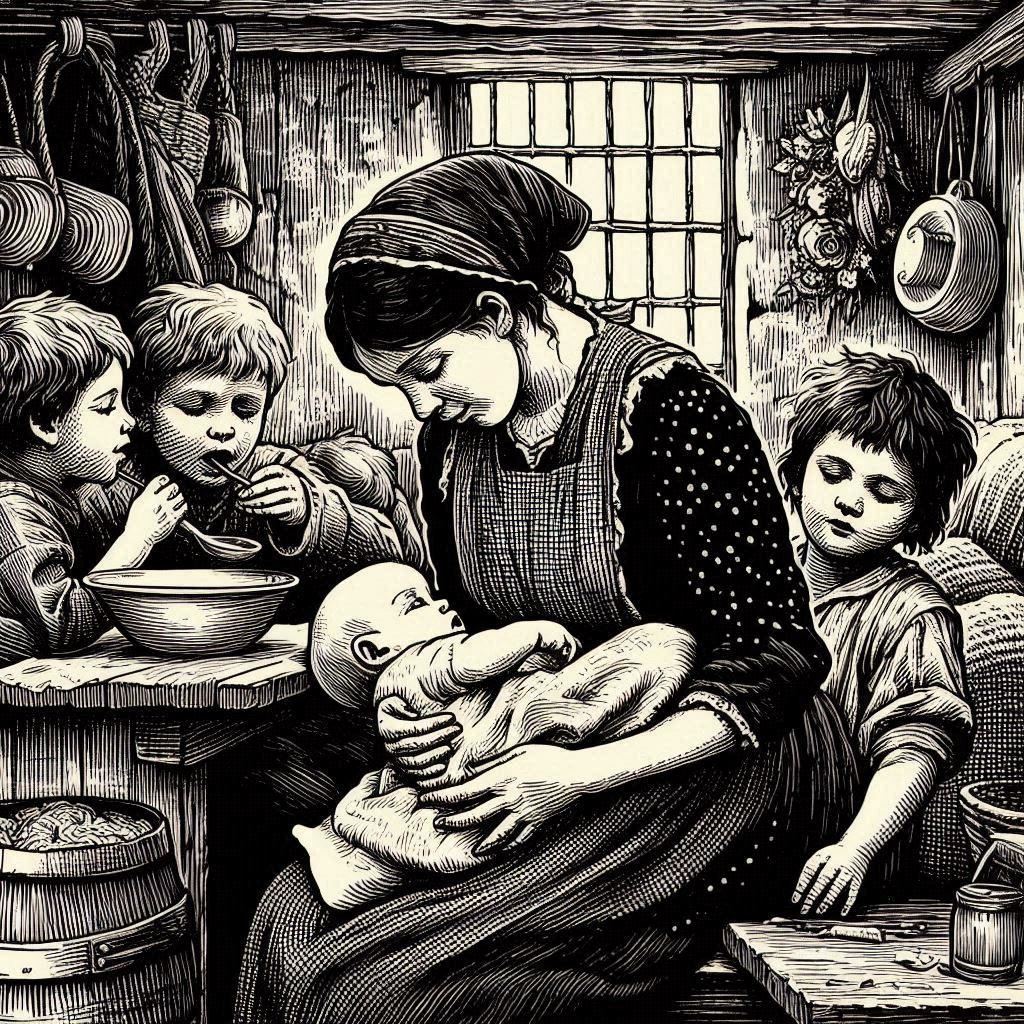
Bottle feeding grew in popularity over the course of the Victorian era. Most advice books of the time strongly advocated maternal breastfeeding. There is some logic in this. A lack of understanding around bacteria and sterilisation meant that baby bottles were often cleaned improperly. This posed a significant source of danger to infants.
Another danger to babies in 1898, was the use of tainted milk. Death rates of bottle-fed babies were much higher than breast fed babies. I wonder if this was Sarah’s experience?
Samuel died two months after contracting gastro-enteric catarrh on 19 August 1898 when he was barely four months old.
Another great sadness for the Campbell family involved Sarah Kilpatrick Campbell born 8 October 1907. The family were now living at Kirkland Rows, Springside, Kilmarnock. Sarah was the eleventh child for this rapidly growing family, and she died from enteritis. This is a related disease to gastro-enteric catarrh. However, enteritis involves inflammation of the small intestine rather than the stomach and intestines. It is caused by infections, whether bacterial, viral or parasitic.
The symptoms that baby Sarah would have experience were abdominal pain and cramps, diarrhea, dehydration, vomiting, fatigue and fever. She died at 7.50am on 6 January 1908 after suffering from these symptoms for two days. Without antibiotics, there were few remedies available to Sarah to help her baby. She was only 13 weeks old.
Sarah and Andrew had another baby who did not survive. The baby was born between the birth of Matthew in 1904 and Sarah’s birth in 1907. This must have been such a heart-breaking time for the family.
During their married life, Andrew and Sarah frequently moved around the outskirts of Kilmarnock. No doubt this happened as Andrew moved from pit to pit for work.
1891 – 10 High Sourlie, Irvine, Ayrshire, Scotland
1901 – 22, Auchenharvie Cottages, Stevenston, Ayrshire, Scotland
1907 – 25, Kirkland Rows, Springside, Kilmarnock
1911 – 28, Gilmour Street, Kilmarnock, Ayrshire, Scotland
1913-15 – Braehead House, Selfish Hill, Hurlford, Ayrshire
1920 – 28, Gilmour Street, Kilmarnock (death of Sarah)
1923 – 21, Gilmour St, Kilmarnock
1930 – 30, Boyd Street, Kilmarnock
1954 • 3, Glencairn Terrace, Kilmaurs, Ayrshire (death of Andrew, living with daughter, Cathie)
As you will notice in the list above, the family moved house several times while the children were young. My grandfather, Matthew, being one of the younger children, made many moves. As a child, he attended school in Hurlford where I would also attend many years later.
Moving day had to be planned and well co-ordinated. Andrew and Sarah would depend on help from their children. They would carry lighter items. Wider family members and neighbours would help load furniture. Handcarts and barrows would be used to carry cast iron pots and pans. Kettles, woolen blankets and homemade quilts, oil lamps, brushes and washboards, all had to make the journey. Heavier wooden furniture was carried by horse-drawn cart. This would be paid for by the family or, if they were lucky, borrowed from a friend for the day. Wooden tables, chairs, beds, and straw mattresses all had to be moved to the new home.
Sarah’s final home in Gilmour Street, Kilmarnock, had three rooms. These rooms were shared between at least fourteen family members. There was no indoor toilet or washing facilities. It must have been a grueling existence. She had to keep the family fed and free from disease in such close living conditions. She waited for her man to come home from the pit each night. No doubt, he washed in the tin bath in front of the fire.
After attending a wedding at the beginning of May 1920, Sarah fell ill. She collapsed and died suddenly from a cerebral hemorrhage, or stroke. She was only forty-nine years old.
Her life was one of service to others. She endured constant childbirth over a period of twenty years. Her youngest child Cissy, was only seven years old when she died.


Discover more from Discovering My Family
Subscribe to get the latest posts sent to your email.

 Discovering My Family