Who is the oldest relative you remember? It amazes me that I knew my great granny who was born in 1881. I have such fond memories of the woman I remember as a four year old. She had grey hair tied up in a bun, wore tartan slippers, and sat by the fire in her arm chair. More surprising was the very large African grey parrot that perched in a domed cage on the table. No wonder this memory is seared into my mind. The parrot outlived great granny by many years.
Agnes Livingstone Dickie was my dad’s granny, born in Paisley, but lived much of her young life in Beith, Ayrshire. After her marriage to Robert Ballantyne, she lived in Stewarton, Ayrshire, in an upstairs appartment in a house called Gameshill. Here she brought up her five children, four boys and a girl.


The highlight of my visit to great granny’s was a little brown envelope. She would hand this to me containing a silver sixpence. Real treasure for a four-year-old. She had kind eyes and a sweet smile and I can easily understand why my dad loved her so much. He spent many of his boyhood weekends traveling by bus from Hurlford in Ayrshire, to Stewarton to visit his granny. No doubt he would be looking forward to a plate of granny’s soup on arrival.

Before her marriage, Agnes worked as a French polisher in Beith, Ayrshire. In the second half of the nineteenth century, Beith was the most important furniture manufacturing town in Scotland. It had a reputation for high quality design and products. So, it is no surprise that young Agnes found work there.
French polishing is a wood finishing technique. After many coats of shellac and a lot of rubbing, a beautiful high gloss finish is given to furniture. Young Agnes must have spent many months and years perfecting this technique. She would start on smaller pieces and work her way up to the more expensive tables and cabinets.
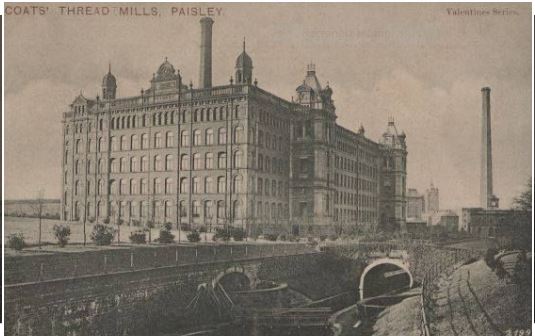
Great Granny’s parents, Ellen McFarlane and James Dickie, both worked in Paisley’s textile industry. Before marriage, Ellen, living at 2, Silk Street in Paisley, was a threadmill worker during the 1870s. Possibly she worked in the mill owned by the Coates brothers, pictured below. Coates senior started the business, producing twisted silk yarn. His sons developed the company into a world-wide business empire.
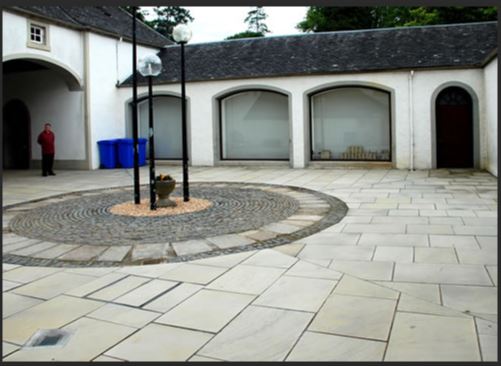
Agnes’s father, James Dickie, was born in Largs, Ayrshire. He spent part of his boyhood at Rozelle Estate in Ayr. His father, Alexander Dickie, was a coachman to the family of the estate. I have visited Rozelle often and even had artwork displayed in the beautiful MacLauren Gallery. In 1975-76 the gallery was created from the servant’s quarters and stable block. I had no idea, at the time of my visit, that my 3x great grandfather had lived and worked in this place over 100 years ago.
Rozelle House was built by the Hamilton family and finished in 1760. The family made their fortune through slavery in the West Indies. The house is named after the former property they owned in Jamaica. Their sugar plantation of 3680 acres in St Thomas-in-the-East had 166 slaves.

By the age of sixteen in 1871, James Dickie, had moved with his family from Rozelle to Paisley. Young James found work as a scourer in the textile industry. Scouring was the process of preparing and washing a batch of raw sheep’s wool to remove impurities such as grease and dirt. It would have been hard, physical work for a strong young lad. By the time of his marriage in 1877, twenty-one-year-old James found work as a gardener, like his father before him. No doubt he enjoyed working in the fresh air away from the noisy and pungent smelling mill.
James was the eldest son of Alexander Dickie and Elizabeth Grieve. In 1855, they both worked at Curling Hall in Largs, Ayrshire, where they had met. Elizabeth was a domestic servant, aged twenty years and Alexander was a thirty-one-year-old gardener.
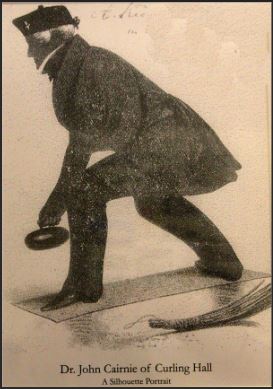
Curling Hall was built by curling enthusiast Dr John Cairnie in 1812. He was a founder member of Largs Curling Club and made Scotland’s first artificial curling pond at Curling Hall. The pond was made from a pavement of finely dressed freestone three inches below ground level. It was then flushed with a little water when frost was approaching to create the ice. Dr Cairnie was very proud of his rink. If the wind caused the ice to be rough, he would employ two joiners from Largs to plane the ice smooth.

When Alexander and Elizabeth worked in this magnificent house, Curling Hall was owned by John Clark. He made his fortune in cotton thread manufacturing. He developed the grounds by building stables and conservatories, no doubt where Alexander would tend fruit. The rink was removed and replaced with a tennis court, showing the change in the pastimes of the rich.
Alexander and Elizabeth married on 1st June 1855 in the Manse of Paisley Abbey. Elizabeth was eight months pregnant, a result of her dalliance with the older gardener. The couple left Curling Hall and a few years later, in the 1861 census, they were living and working in Rozelle. Together they had nine children. Alexander and Elizabeth had moved to Paisley by 1871. He was working as a gardener once more, and would do so until his death around 1890.
What an interesting journey my great grandmother has taken me on in my family history research. All bases have been covered. From memories of a large African parrot, through an estate built from the profits of slavery, to curling rinks and French polishing. All ordinary working folk playing their part in the rich tapestry of my family’s history.

Discover more from Discovering My Family
Subscribe to get the latest posts sent to your email.

 Discovering My Family